You hear “AI progress proves we’re in a simulation”—what exactly is being claimed?
You’ve probably seen the pattern: a new model writes code, chats smoothly, or imitates a style, and someone says it “proves” we’re in a simulation. In day-to-day terms, that claim usually bundles three different ideas that get treated like one: (1) computers can now produce behavior that looks like thinking, (2) therefore minds are “just computation,” and (3) therefore a bigger computer could run our whole world.
Each step changes the kind of statement being made. The first is about observable performance. The second is a theory about what minds are. The third is a guess about where our universe sits in a stack of realities. If you don’t separate those moves, you can’t tell whether you’re evaluating evidence, a definition, or a story.
So the useful starting question isn’t “are we simulated?” It’s: which step is the speaker asking you to accept, and what would count as a check on it?
When a model feels like a mind, deciding what counts as real evidence
When a demo feels like you’re talking to a colleague, it’s easy to treat that feeling as evidence of a mind behind the text. In practice, you’re usually reacting to a bundle of cues—fast turn-taking, plausible explanations, confident tone—and then sliding from “this is useful” to “this is aware.” That slide happens because human conversation is one of the few signals we’re trained to treat as high-trust.
A cleaner check is to ask what the model can do when you remove the social surface. If you give it a problem with a known answer, can it stay consistent across rephrasings, show its work, and admit uncertainty in a way that predicts fewer errors later? If it can’t, then the “mindlike” vibe is more like a user-interface effect: it changes how you relate to the output, not what the system is.
The stronger evidence often looks less impressive. Tool-use logs, controlled evaluations, and failure patterns feel dry compared to a clever chat, but they’re the only things that let you separate performance you can measure from stories you can’t.
The leap from ‘we can simulate’ to ‘we are simulated’—where the inference actually breaks
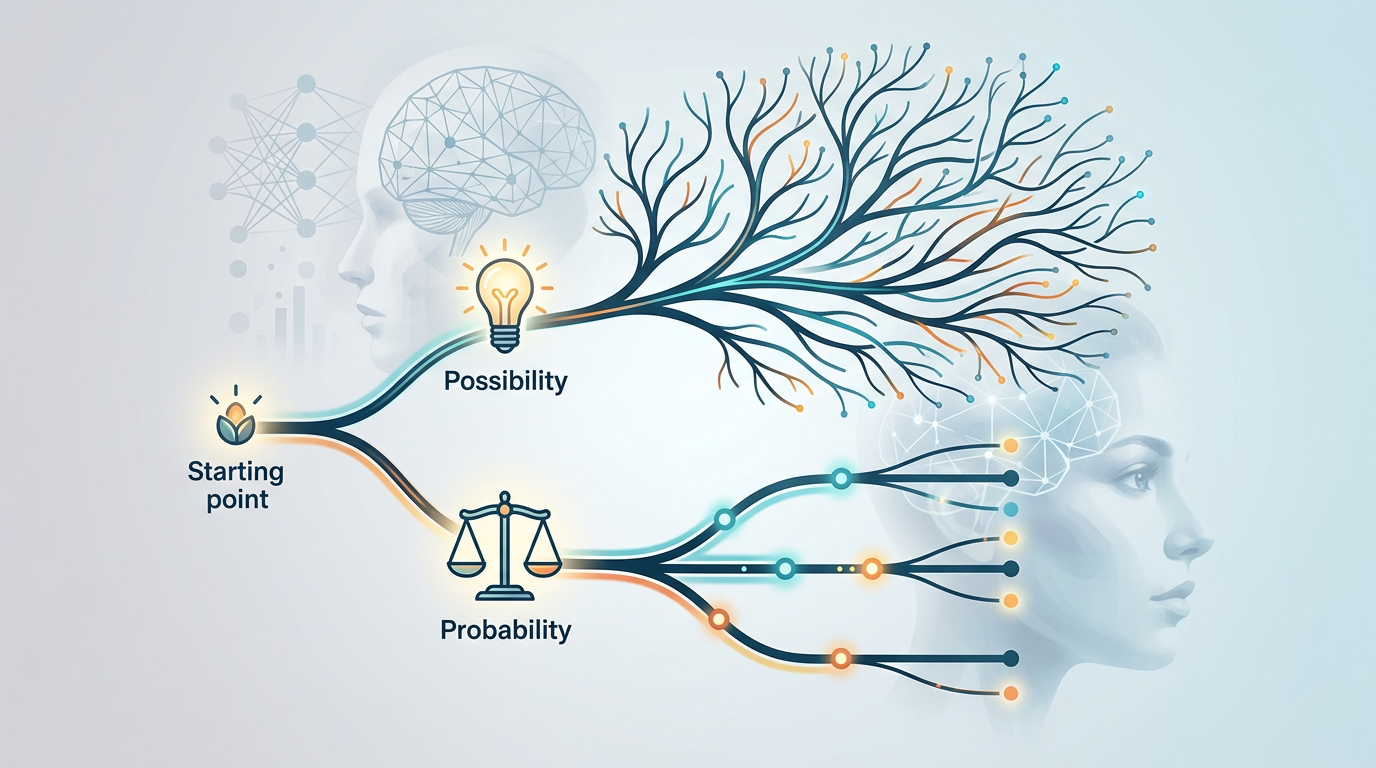
Once you’ve separated measurable performance from stories you can’t test, the “we can simulate” jump starts to look like a category error people make in everyday reasoning. If you can render a realistic city in a game engine, that shows a method for producing a convincing scene. It does not raise the odds that your own city is rendered unless you add more facts about who would run it, why they would, and what constraints they face.
The inference breaks because possibility isn’t probability. Today’s models show that some mindlike behavior can come from computation, not that every mind must come from the same kind of computation, and not that the most likely place for minds to exist is inside someone else’s machine. You also don’t get new evidence about your own world’s “hosting” just because you improved your tools.
The practical trade-off is attention: the simulation claim feels decisive, but it often blocks the more useful question—what “layers” could mean in systems you can actually inspect.
Layered intelligence without sci‑fi: what ‘levels’ mean in systems you can inspect
That question—what “layers” could mean in systems you can actually inspect—usually comes up when you watch a model act like it’s juggling multiple roles at once: it chats, calls tools, follows policies, and adapts to your tone. In real systems, those “levels” aren’t hidden universes. They’re separable parts: the base model’s learned patterns, a wrapper that formats prompts and routes requests, external tools that fetch facts or run code, and guardrails that block certain outputs.
If you want a grounded way to talk about levels, ask: which part would I change to change this behavior? A wrong answer that disappears when you add retrieval points to missing information, not “a deeper mind.” A refusal that flips when you remove a policy layer points to enforcement, not capability. These are levels you can test with ablations, logs, and A/B runs.
The friction is that layering buys control but adds failure modes. Tool chains can break, orchestration can hide where errors enter, and guardrails can look like “intent.” Once you can name the layer, you can argue about claims without drifting into “stacked realities.”
If reality had layers, what would change in your day-to-day predictions?
If you take “layers” seriously as a claim about reality, it should change what you expect to happen when you poke the system. In your day-to-day life, most predictions assume one stable set of rules: your tests run the same tomorrow, your GPS doesn’t “decide” to lie, your colleagues see the same dashboard numbers. A layered-reality view only earns its keep if it implies detectable quirks beyond ordinary noise.
Concretely, you’d look for seams: places where the world behaves like it’s being approximated or selectively rendered. Think about repeatable “observer effects” that are stronger than measurement interference—results that change depending on whether you check, not just how you check. Or resource limits that show up as consistent shortcuts: rare edge cases that always degrade in the same direction when situations get complex.
The trade-off is that most “weirdness” has cheaper explanations—bad sensors, biased sampling, incentives, or human error. If your layered hypothesis doesn’t improve your forecasts over those, it’s not a working model; it’s a story you can’t use. The next step is learning to spot when a claim is built so it can’t lose.
Spotting unfalsifiable talk before it hijacks the discussion

That “story you can’t use” move shows up in conversation as a claim that never has to pay rent in predictions. You’ll hear it when someone treats every outcome as a win for the simulation: if the world looks consistent, that’s “good rendering”; if it looks inconsistent, that’s “a glitch”; if you can’t measure it, that’s “the point.” At that point, you aren’t debating evidence. You’re debating a script.
A quick test is to ask for a loss condition in plain language: what observation, on a concrete timeline, would make you less confident? If the answer is “nothing could,” or it shifts to “the simulators would hide it,” the claim has insulated itself from contact with data. Another tell is when the speaker swaps levels mid-sentence: using tool-chain quirks in AI systems as if they were clues about physics, without saying what would transfer and why.
The practical friction is social: pushing for falsifiability can sound like you’re killing the fun. The fix is to offer a fork—“Is this a metaphor, or a testable claim?”—and keep the rest of the discussion on the branch that can actually change your mind.
So how seriously should you treat the simulation hypothesis around AI?
If you force a loss condition, most AI-linked simulation talk collapses into “maybe” with no follow-up test. Treat that as entertainment, not evidence. The useful, serious version is narrower: “Could minds be computational, and could our observations be produced by some process we don’t see?” That’s a live research question in pieces, not a single conclusion you can cash out from a new model launch.
So in conversation, keep a simple rule: upgrade your beliefs only when a claim changes what you’d predict next week. If it doesn’t change how you evaluate model behavior, measure failures, or reason about physics, park it as speculation. That lets you stay curious without letting a story outrank the logs.