When pilots succeed but scaling stalls
A pilot goes live fast: one team, one dataset, one sponsor who can clear obstacles in a day. It demos well, the model looks “accurate,” and the business asks for the same result across regions, products, or channels.
That’s when progress slows. The data you need sits in three systems with different definitions, access rules, and refresh cycles, so the “same” use case behaves differently in production. A customer record with outdated consent, a missing audit trail for how a feature was derived, or an identity mismatch between CRM and billing can turn a clean prototype into a deployment that security, legal, or operations won’t sign off on.
The uncomfortable part is cost. Standardizing and governing data takes months, pulls scarce engineers, and can feel like it delays visible wins—until you realize each new pilot is quietly paying that bill anyway. The hard question becomes whether your first-party data is the advantage, or simply the price of admission.
Is first‑party data actually your edge—or just table stakes?
Price of admission feels different when the “ticket” costs a quarter’s worth of engineering time. In most enterprises, first-party data starts as table stakes because it’s the only data you can consistently tie to your processes, your customers, and your policies. If your sales and service teams can’t agree on what “active customer” means, a vendor model won’t save you; it will just produce confident answers on shifting ground.
Your edge shows up when your first-party data captures something others can’t: proprietary signals, closed-loop outcomes, or workflow context. If you can link a case note, the next-best action taken, and the eventual resolution, you can train and evaluate on what “good” looks like in your operation—not a generic benchmark.
The catch is that “more data” isn’t the same as “usable data.” Consent gaps, missing lineage, and brittle identity joins create the kind of risk that forces you back into pilots. The fastest way to decide is to ask: can this data be used repeatedly, legally, and with the same meaning next month?
A use case that “should work” but keeps failing in production

“Same meaning next month” is exactly where a common use case breaks: a support copilot that drafts answers using past tickets, product docs, and customer history. In a pilot, it pulls from a clean export and impresses everyone. In production, the answer quality swings by region or channel because ticket categories don’t map, macros changed without notice, and “resolved” means different things in different tools.
Then the real blockers show up. The model needs recent interactions, but the freshest data sits behind a system that only syncs nightly. It needs customer context, but the CRM ID doesn’t reliably match billing, so it grabs the wrong plan details. Legal asks where consent is recorded for using chat transcripts, and you can’t prove it for a meaningful slice of traffic, so the safest option becomes “don’t use that field.”
The failure looks like “the model isn’t ready,” but the root cause is usually data you can’t use consistently, safely, or on time.
Before choosing platforms, map what data you can legally and reliably use
That map starts with a simple inventory: what tables, documents, transcripts, and event logs the use case would touch, and where they live today. For each source, write down who owns it, how often it refreshes, and how you’d reproduce the same extract next month. If a dataset only exists as a one-time export from someone’s admin console, it’s not a dependable input for production.
Then run two filters that usually get skipped until the last minute. The legal filter: what consent covers, what retention allows, and whether the intended use matches how the data was collected (for example, “support” chat logs used for “marketing” personalization). The reliability filter: identity joins that hold up across systems, fields that are consistently populated, and lineage you can explain to security when they ask how a feature was derived.
This takes time and creates uncomfortable conversations, especially when a “high-value” source turns out to be off-limits or too stale to meet a workflow SLA. But once you see what’s usable, the next decision gets clearer: which first-party datasets deserve your limited cleanup budget.
Which first‑party datasets deserve priority when everything is messy?
Limited cleanup budget forces a sharper question than “what’s valuable?”: what can you make dependable across teams without rebuilding half your stack. Start with datasets that sit closest to the workflow you’re trying to change and can be tied to an outcome. For a support copilot, that usually means (1) the canonical customer/identity record, (2) the case/ticket history with stable status and category definitions, and (3) the knowledge base or product docs that agents are actually supposed to use.
Then prioritize “join strength” over volume. If CRM-to-billing matching fails 15% of the time, every downstream feature inherits that error. Fix the keys, reference data, and consent flags before you tune prompts. A smaller, clean slice beats a larger, fuzzy one.
The practical snag is politics: these sources have different owners, and standardizing definitions can stall in committees. That’s why the next step is to define the minimum data capability you need so the same datasets stay usable after the first rollout.
The minimum data capability to move beyond one-off copilots
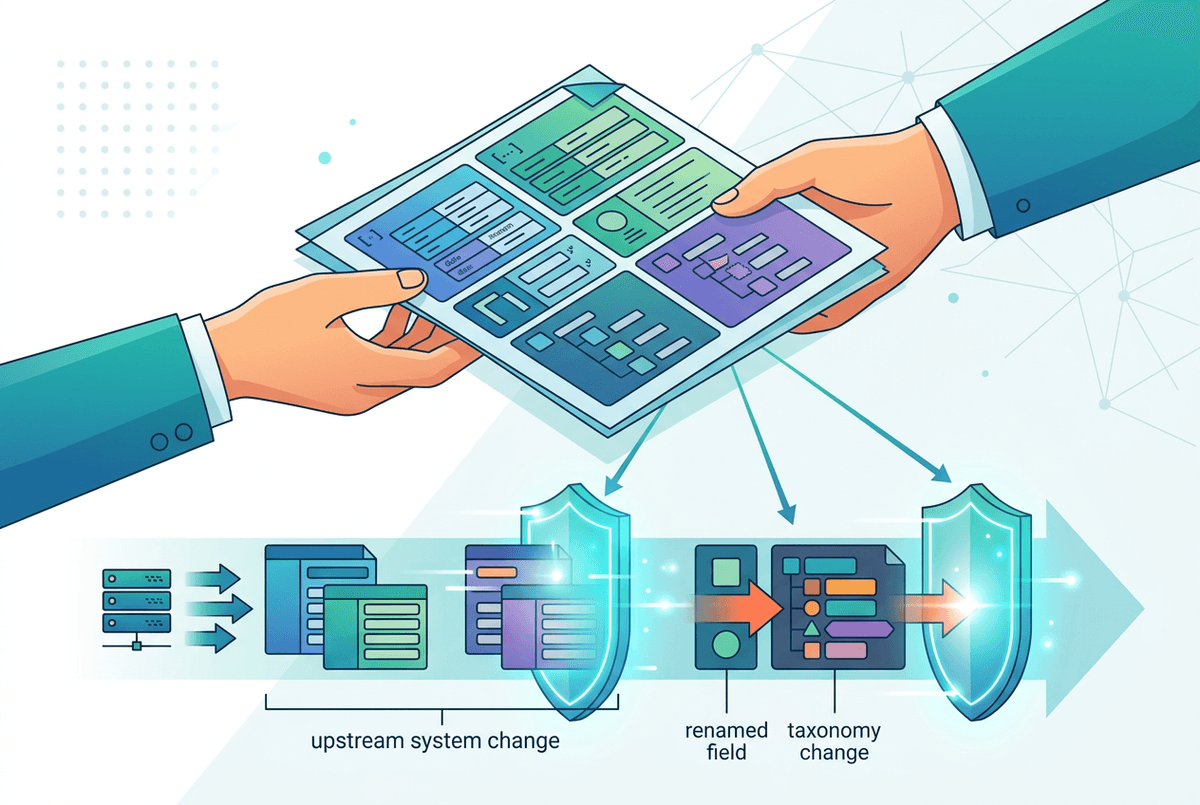
Keeping the same datasets usable after the first rollout usually breaks in boring places: a field gets renamed, a ticket status taxonomy changes, or a consent flag stops syncing. If your copilot depends on “whatever the latest export looks like,” every change becomes a fire drill, and teams quietly freeze the scope to avoid risk.
The minimum capability looks like a small set of guarantees, not a big platform. You need one governed access path (so the model always reads from the same place), versioned definitions for key fields (so “resolved” doesn’t drift), and a repeatable identity join that fails loudly when match rates drop. You also need lineage you can explain in plain language: where each input came from, when it refreshed, and who approved its use.
The real cost is operational. Someone has to own data contracts, monitor freshness, and handle exceptions when upstream systems change. Once that’s in place, you can add new copilots without renegotiating legality and meaning every time.
Where vendors and third‑party data fit without surrendering control
Not renegotiating legality and meaning every time is also what lets you use vendors without letting them redefine your data. Treat third-party tools as accelerators for delivery—UI, orchestration, evaluation harnesses, managed vector stores—not as the system of record. If a copilot works only when your data is copied into a vendor-managed format you can’t audit, you’ve swapped one bottleneck for another.
Third-party data can help when it fills a real gap: enrichment for firmographics, sanctions screening, address normalization, or industry benchmarks. But only if you can trace exactly what was added, when it expires, and where it’s allowed to flow. Otherwise, a single “helpful” enrichment field can contaminate downstream training sets or break retention commitments.
Make the boundary explicit: vendors read through your governed access path, outputs land in your logging and policy controls, and you can switch providers without rewriting the business logic. That boundary is what you can start committing to over the next 90 days.
What you can commit to in the next 90 days
That boundary becomes real when you turn it into a 90-day plan with owners, dates, and a definition of “done.” Pick one production use case and lock the inputs: the exact systems of record, the fields you will use, and the refresh SLA you can meet. Then put it in writing as a data contract so a renamed field or new status value doesn’t silently change the model’s behavior.
In parallel, close the two gaps that most often stop sign-off: provable consent/retention for the sources you’re about to use, and a monitored identity join with a threshold that triggers an alert when match rates drop. Expect pushback when you ask teams to standardize definitions or expose lineage; it takes real time, and it can feel like “extra work” until an audit or incident forces it. End the quarter with one governed access path, one evaluation harness tied to workflow outcomes, and logs that land in your controls—not a vendor’s.