You hit the wall: the model is “right,” but users feel it’s broken
You ship the “best” model in offline tests, and the first complaint is simple: it feels slow. Users don’t care that the answer is technically correct if the UI stalls, the voice assistant talks over them, or moderation blocks the page for a second. In real time, delay reads as failure.
Then you try the faster model and a different complaint shows up: it fires too many wrong calls. A fraud check flags good customers, ranking feels random, a safety filter misses obvious edge cases. Cleaning up the fallout takes people time and burns trust.
The wall is this: the product promise is non-negotiable, so the work starts by turning that promise into a hard latency budget you can defend.
What latency do you actually have, once the product promise is non‑negotiable?
A “hard latency budget” only helps if it matches what the user experiences. The promise is rarely “model responds in 300ms.” It’s “results appear as you type,” “the card swipe goes through,” or “the page loads without a pause.” That’s end-to-end, and it includes UI work, network hops, gateway queues, feature fetches, logging, and retries.
Start by fixing the one number you can’t negotiate: the user-visible deadline at the 95th or 99th percentile, not the average. If your search box must update in 200ms p95, and the frontend render plus network takes 80ms on a typical mobile connection, you don’t have 200ms for inference—you have 120ms, and less on a bad day. The uncomfortable part is that “bad day” happens regularly: cold starts, cache misses, regional failovers, and bursts that create queueing.
Once the deadline is real, decide what happens when you miss it: return stale-but-safe results, fall back to a smaller model, or skip enrichment. Those rules define the latency you actually have.
Turning an end-to-end SLA into a model inference budget without guessing
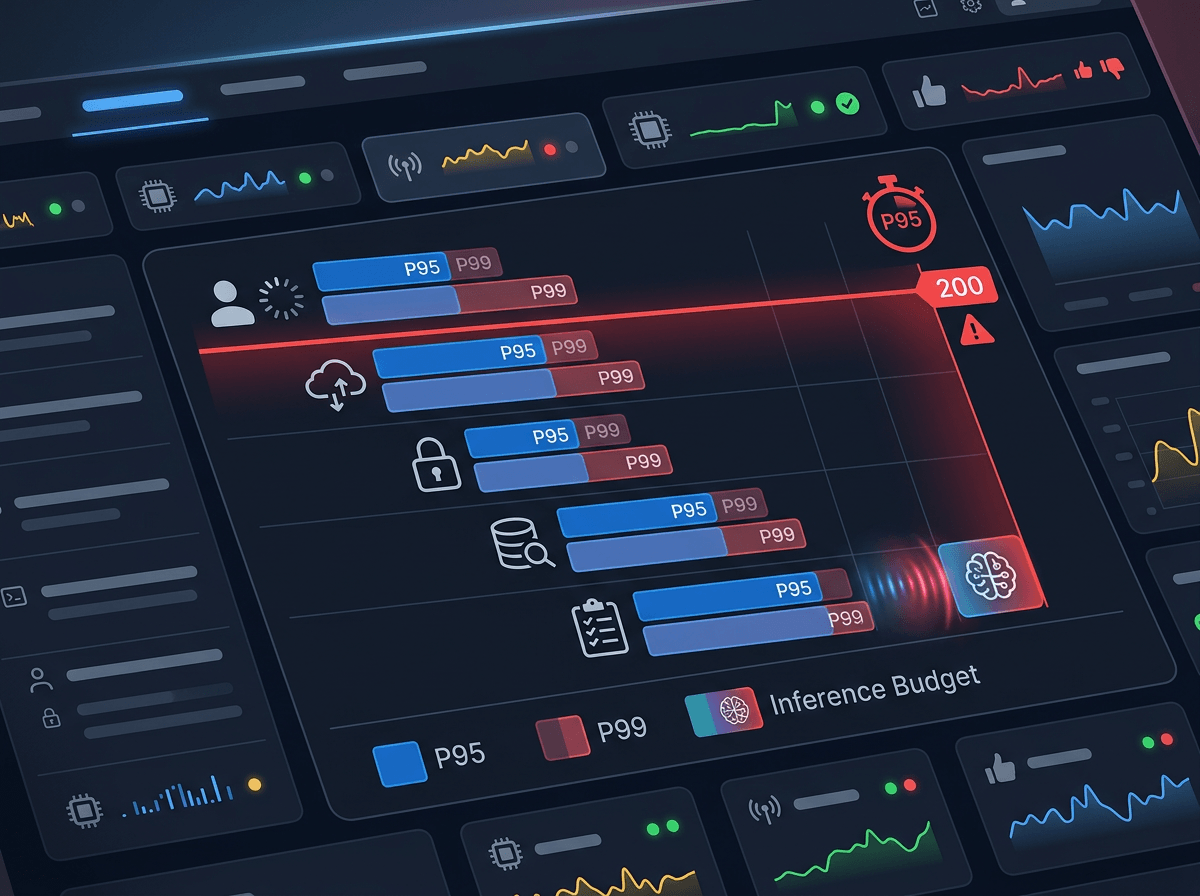
Those fallback rules are where you stop debating “is 120ms enough?” and start deciding what the model is allowed to spend. Take the user-visible deadline (say 200ms p95) and treat everything that isn’t inference as fixed overhead until proven otherwise: frontend render, network, auth, feature reads, and any mandatory logging. Measure that overhead at p95 and p99, not from a happy-path trace, then subtract it to get an inference budget that already includes the messy parts—queueing, cold starts, and occasional retries.
Now split the inference budget into pieces you can control: time to load or fetch the model, time to build inputs, and time to run the forward pass. If you need 120ms end-to-end for “model work,” you might cap tokenization and feature assembly at 20ms p95, reserve 10ms for safety checks, and give the core pass 90ms. That lets you test changes without guessing: a bigger model that adds 25ms has to “pay for itself” somewhere else.
The catch is that your budget must survive bursts. If a 90ms pass becomes 200ms under load because requests queue, your real budget is lower unless you pay for more capacity or accept more fallbacks.
Your bottleneck isn’t always the model: find the real time sinks first
When that 90ms pass turns into 200ms under load, it’s tempting to blame the model. In practice, the extra time often shows up before inference even starts: requests sit in a gateway queue, a feature store read stalls, or a cold shard adds a retry. The model gets blamed because it’s the last visible step, not because it’s the slowest one.
Pull a p95/p99 trace and label time by stage: client-to-edge, edge-to-service, auth, feature fetch, input build, model queue, forward pass, post-processing, and logging. Then look for “long tails,” not just big averages. A 15ms feature call that becomes 120ms on cache miss will break your SLA more reliably than shaving 5ms off inference.
The annoying constraint is ownership: the slowest hop might be a shared datastore or a vendor SDK, and fixing it can mean contract changes, schema work, or paying for more capacity. Once you know what’s truly slow, you can decide which delays are acceptable—and which wrong calls become the real risk.
When accuracy drops, which mistakes create real business risk?
Those “wrong calls” aren’t equal. In a fraud check, a false positive can block a good customer and trigger support tickets; a false negative can mean direct loss. In moderation, an over-block might cause creator churn, while an under-block can create policy and PR exposure. If you don’t separate these, “accuracy dropped 2%” becomes a useless argument.
Start with a small error taxonomy tied to outcomes: which mistakes cost money, which cost trust, and which are just annoying. Then quantify with a confusion-matrix view at the threshold you actually ship: false-positive rate on high-value users, miss rate on the top unsafe categories, and the volume those rates create per day. Put a dollar or time estimate next to each bucket, even if it’s rough.
The hard part is getting labels fast enough; many teams only have clean ground truth weeks later. That’s why the fastest wins often come from reducing avoidable mistakes before swapping models.
Speed wins you can take before changing the model
That “avoidable mistakes” line is also where you usually find easy latency wins, because you can stop doing work you don’t need. If the same user query, merchant, or document shows up repeatedly, cache the model result (or an embedding) with a short TTL and a clear invalidation rule. If you can’t cache the output, cache the expensive inputs: feature joins, policy lists, or prompt templates.
Then tighten the path around inference. Batch where it’s safe (server-side micro-batching for ranking or moderation), but cap the wait time so batching doesn’t create its own p99 spike. Use early exits: stop once confidence clears a threshold, or skip deeper checks when a cheap rule says “obviously safe.” Keep token counts bounded; long prompts and long outputs quietly blow budgets.
The practical downside is operational: caches go stale, batching increases tail latency under bursts, and early exits can hide edge cases. Once you’ve taken these wins, you’re ready to decide whether you need a fast/slow split instead of one model path.
Choosing a deployment pattern when one model can’t satisfy both sides
That fast/slow split usually shows up when you’re tired of arguing about one “best” model and start designing for what happens on the hard deadline. In a familiar pattern like search, you can return a fast answer in-budget (light model or cached result), then refine asynchronously when the slower model finishes. Users get a response now, and you still get higher-quality results when it matters—like updating the next keystroke, the next page, or the “details” view.
If you can’t change the UI or the decision must be synchronous (fraud, hard blocks), use a tiered path: a fast gate runs first, and only the uncertain slice escalates to the slower model. You keep p95 under control because most traffic stays on the cheap path. The constraint is capacity planning: if “uncertain” becomes 30% during an attack or a news spike, your slow tier queues and the whole system degrades.
When neither split is viable, pick a single model and make the fallback explicit: what you return at timeout, who gets retried, and which errors you refuse to ship. Those choices set up the stakeholder conversation about guardrails and rollout triggers.
What you’ll tell stakeholders: acceptance metrics, guardrails, and rollout triggers

Those timeout and fallback choices only work if everyone agrees on what “acceptable” means when the system is under pressure. Bring stakeholders a short acceptance sheet with three numbers: end-to-end latency at p95/p99, the percent of requests that hit a fallback path, and the error rates that map to business pain (for example, fraud false positives on high-value users, or moderation misses on top-severity categories).
Then define guardrails that are easy to monitor in production: maximum token count, max queue time before you skip the slow tier, and a hard cap on “uncertain” traffic that can escalate. Add a concrete kill switch: if p99 exceeds the user deadline for 10 minutes, or fallback rate doubles from baseline, you automatically freeze rollout, route traffic to the fast path, and page the owner.
The real difficulty is instrumentation and labeling speed. If you can’t get near-real-time outcomes, your triggers must lean on proxies (complaint rate, chargebacks, manual review volume), which are noisy but still better than guessing.
Making the trade-off feel less like compromise and more like an engineered choice
If your triggers rely on noisy proxies, the decision can feel like “ship faster and hope.” You can change that by treating speed and accuracy as two separate budgets you spend on purpose: milliseconds for each stage, and risk for each error bucket. Then every change has to state what it buys and what it costs. Example: “We save 40ms p99 by skipping enrichment on cache miss; it increases manual review by 3% on new merchants.”
The real constraint is that budgets drift. Traffic shifts, attacks happen, and the “uncertain” slice grows. Plan for that explicitly: pick a default behavior at timeout, set a hard cap on slow-tier escalation, and tie it to a weekly review where you either pay for more capacity, tighten thresholds, or accept a narrower product promise.